Member-driven advocacy advances business priorities during 2026 legislative session
 The 2026 Missouri legislative session concluded May 15 with meaningful progress on several policy priorities important to Springfield-area employers, economic development and long-term regional competitiveness.
For the Springfield Chamber, the end of session is also an opportunity to reflect on the value of a member-driven advocacy process. Each year, Chamber members help shape the organization’s legislative priorities by identifying the issues most important to business growth, workforce development, infrastructure, quality of place and a competitive economic climate.
That process guides the Chamber’s engagement in Jefferson City and ensures advocacy efforts are rooted in the real-world needs of employers across the Springfield region.
Business Priorities Advanced
This session saw progress on several issues Chamber members consistently identify as important to doing business in Missouri: a more predictable legal environment, stronger economic development tools, continued investment in infrastructure and practical solutions that help employers compete for talent.
One of the clearest wins came in the area of legal reform. Lawmakers approved SB 907, legislation designed to address abusive website accessibility lawsuits — a growing concern for businesses facing technical claims that often appear designed to secure quick settlements rather than resolve accessibility issues. The Chamber supported the measure because it helps preserve legitimate accessibility protections while giving businesses a fair opportunity to fix potential issues without becoming the target of predatory litigation.
The session also produced meaningful movement on economic development. HB 3231, a broad package creating the Missouri Innovation, Public Safety, and Accountability Act, includes new tools designed to support job creation, business retention, redevelopment, housing activation, public safety, infrastructure and private investment. For communities like Springfield, these types of tools are important as cities work to keep commercial districts strong, attract new investment and support long-term growth.
Infrastructure remained another important focus. SB 916 provides additional liability clarity for private-sector partners working on certain Missouri Department of Transportation projects under state-approved plans and specifications. That kind of clarity matters because public infrastructure projects often depend on collaboration among state agencies, contractors, engineers and other partners. A more predictable framework helps reduce uncertainty and supports continued investment in critical transportation improvements.
Lawmakers also advanced HB 2596, which expands access to pooled employer health plans for small and family-owned businesses. For many small employers, affordable health coverage is one of the most important tools they have to attract and retain workers. Expanding access to pooled employer health plans, including options like the Chamber Benefit Plan, supports both small business competitiveness and workforce stability.
Finally, the session included progress on land bank usage through SB 973, an issue tied closely to redevelopment, housing and quality of place. Stronger land banks can help communities address vacant or underutilized properties and return them to productive use. For Springfield, that kind of policy tool supports broader efforts to encourage reinvestment, strengthen neighborhoods and create new opportunities for growth.
Together, these measures reflect the range of issues that shape the business environment — from litigation costs and employee benefits to infrastructure, redevelopment and long-term community competitiveness. They also show the value of sustained advocacy focused on practical policy solutions that help employers grow and invest.
Budget Investments Support Regional Priorities
In addition to policy legislation, the General Assembly approved a roughly $50.7 billion Fiscal Year 2027 state operating budget that includes several investments aligned with Chamber priorities in education, workforce development, infrastructure, public safety, health care access, economic development and quality of place.
For the Springfield region, several budget items are especially relevant. Investments in Ozarks Technical Community College’s Center for Workforce and Student Success, Missouri State University capital projects, Missouri One Start community college training, the Fast Track Workforce Incentive Grant Program, the Upskill Credential Training Program and registered apprenticeship expansion all support the Chamber’s continued focus on strengthening the region’s talent pipeline.
The budget also includes major transportation and infrastructure investments, including funding for the I-44 Improvement Fund, an I-44 environmental impact study and broadband infrastructure. Economic development and community investment items include a reappropriation for a Springfield regional convention center complex and funding for Missouri supplemental TIF projects, including Springfield Jordan Valley Park and IDEA Commons.
These investments reflect the Chamber’s ongoing focus on the foundational assets that support business growth: a strong workforce, reliable infrastructure, quality education and tools that help communities compete for jobs and private investment.
Because the Governor has line-item veto authority, specific budget items may still be removed or reduced before the new fiscal year begins July 1. The Chamber will continue monitoring final budget action and its impact on regional priorities.
Workforce Challenges Remain a Priority
While several Chamber priorities advanced during the 2026 session, other workforce-related proposals did not reach the finish line. Two of the most notable were child care tax credits and expanded income eligibility for the Fast Track Workforce Incentive Grant.
Access to affordable, quality child care remains a major barrier to workforce participation for families and employers across Missouri. HB 2409 would have created tax credits to support child care providers, employers investing in child care solutions and families paying for care. The Chamber supported the proposal because of its direct connection to workforce availability, employee retention and economic growth.
The Chamber also supported efforts to expand access to the Fast Track Workforce Incentive Grant, which helps working adults pursue credentials in high-demand fields. HB 2151 and SB 1452 would have increased income eligibility thresholds for the program and made it available to more Missourians seeking to upskill or return to school.
Although these proposals did not pass this session, the issues behind them remain central to Missouri’s workforce needs. Child care access, short-term training and upskilling opportunities will continue to be important policy conversations as employers work to attract, retain and develop talent.
Advocacy Rooted in Member Priorities
The outcomes of the 2026 legislative session underscore the importance of keeping the business community engaged throughout the policymaking process.
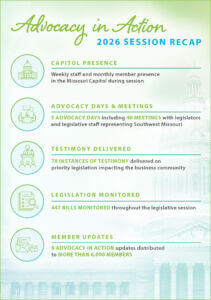
Throughout the session, the Chamber’s public affairs team worked with members, the Legislative Policy Committee, Chamber leadership and regional partners to evaluate proposals, provide testimony, communicate with lawmakers and advocate for policies that support economic growth.
That process ensures the Chamber’s voice in Jefferson City is shaped by the practical needs of employers working to grow, hire, invest and serve the community.
The Chamber is grateful for the continued engagement of its members and the work of the region’s legislative delegation throughout the 2026 session. While not every priority advanced, the session produced meaningful progress on issues that strengthen the business climate and support long-term regional competitiveness.
As final action on approved legislation and budget items continues, the Chamber will keep members informed and continue working to advance policies that support a strong economy, a skilled workforce and a competitive future for the Springfield region.
Stay Connected to Chamber Advocacy
Your voice helps shape the Chamber’s advocacy priorities. Stay connected by following our legislative updates, engaging in upcoming advocacy opportunities and reaching out to the Public Affairs team with issues impacting your business.